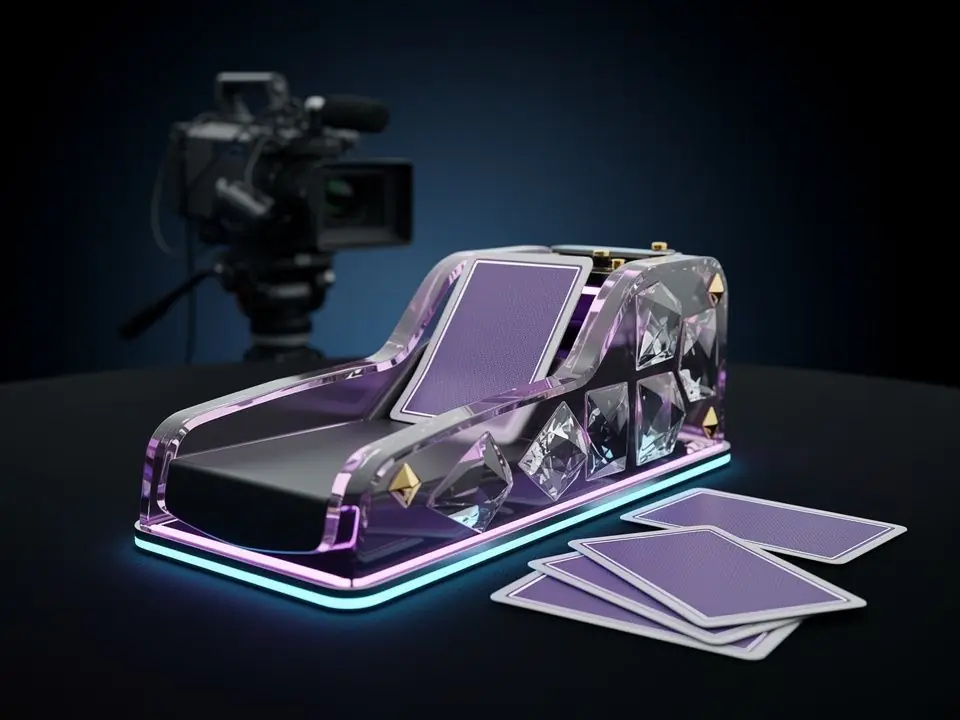
From the player's side, a live dealer game looks simple: a dealer, a table, a countdown and a betting grid. Behind that picture runs a production operation that combines television broadcasting, casino procedures and real-time data processing. Knowing how it works helps operators choose providers, set realistic expectations and explain the product to their players. Here is what happens behind the camera, step by step.
The concept in brief
Live casino blends two worlds. The game itself is run by a trained dealer at a physical table, in a purpose-built studio or on a land-based casino floor. Everything financial is digital: players bet through an on-screen interface, the provider's system settles each round and winnings are credited to the player's balance automatically. The dealer never touches money, and that is the main operational difference from a traditional casino.
Players can join from a computer, a phone or a tablet, at any hour, and still get the human contact of a real table.
Where the games are filmed
Providers rely on three main set-ups, often side by side:
- Purpose-built studios. Rows of tables, each on its own lit set with sound insulation, staffed by dealers working in shifts around the clock.
- Land-based casino feeds. Cameras installed above real tables let online players bet alongside guests on the casino floor.
- Dedicated and branded tables. Tables reserved for one operator, dressed in its logo and colours and hosted in its players' language.
Cameras, lighting and streaming
Each table is covered by several cameras so the director can switch between a wide shot of the dealer and close-ups of cards, dice or the wheel. On a roulette table, one camera typically frames the dealer and the layout while others follow the ball and capture the winning pocket from above or from the side. Professional lighting keeps card faces and numbers readable on small screens.
The video is encoded and streamed at several quality levels so it adapts to each player's connection. Providers work hard to keep latency low: every second of delay between the table and the screen shortens the betting window and makes chat with the dealer feel less natural.
How a card becomes data
To settle bets, every physical event at the table has to become a digital result. Two technologies do most of this work.
Game Control Unit
Each table has a Game Control Unit, or GCU, a compact device that encodes what happens during the round. Watch a blackjack dealer closely and you will see each card pass over a small scanner before it is revealed: that is the GCU registering its value. On a roulette table, sensors in the wheel report the winning number. The GCU sends this data to the game server, which matches it against the bets placed. In busy games with hundreds of players, this automation is what prevents settlement mistakes.
Optical character recognition
Optical character recognition, or OCR, reads symbols in the video itself, such as card values or numbers, and converts them into data. Studios use it to capture results, build the round history and feed the statistics panels players see.
Thanks to these systems, a player does not just watch "17 black" land on screen. Within moments the interface highlights the winning bets, updates the balance and adds the result to the history.
The people behind the camera
A live studio employs many more people than the dealers on screen:
- Dealers and presenters, trained in game procedures and in talking to camera, often in several languages.
- Floor supervisors and shift managers, who oversee the tables, enforce procedures and resolve disputes.
- Technical crew in a separate control room, who monitor the streams, cameras, GCUs and servers.
- Risk and integrity analysts, who study betting data to detect fraud, collusion and players breaking the rules.
The dealer's monitor
In front of every dealer sits a screen showing how many players are at the table, their nicknames, incoming chat messages and the stage of the round. It lets the dealer welcome new arrivals by name, answer questions and keep track of bets. That personal touch is what separates live casino from any automated format.
What the player sees
Every provider designs its own interface, but four elements appear in practically every live game:
- the video window, often with a choice of camera views or picture quality;
- an interactive betting area with chips, limits and available bets;
- a timer counting down the betting window;
- a chat panel for messages to the dealer and, on some tables, to other players.
Most studios add round history, statistics such as hot and cold numbers, saved favourite bets and a button for tipping the dealer.
Which games are streamed
Almost every live portfolio is built on blackjack, roulette and baccarat, usually in several variants of each. Providers then differentiate with poker games played against the house, money wheels and game shows, and regional specialities. Studios aimed at Asian markets add Sic Bo, Dragon Tiger, Fan-Tan and Xoc Dia, while BetGames.TV made its name with fast lottery-style draws such as Lucky 5 and Lucky 7. Because no single studio covers every format, most operators run tables from several providers.
Live dealer games versus RNG games
An RNG table game uses a random number generator to produce each outcome and can deal a new hand the moment the player clicks. In live casino, the outcome comes from real cards, wheels and dice handled by a person, and rounds follow the dealer's pace. Both formats are tested for fairness, but they serve different moods: RNG games for quick, solo play at any stake, live tables for an immersive and social session. Players who distrust software tend to prefer what they can see with their own eyes.
Why operators invest in live casino
- It is the closest online equivalent of a land-based casino, available on any device.
- A real dealer reassures players who are wary of automated games.
- Conversation with dealers and other players keeps people at the table for longer.
- Multi-table views let players follow several games at once.
- Branded tables and in-stream promotions give marketing teams extra space for their brand.
How to add live dealer games to your casino
There are two routes. You can contract each studio directly, which means a separate agreement, technical integration and certification check for every provider. Or you can connect through an aggregator that already holds those integrations. Either way, compare the licences each studio holds in your target markets, the languages of its dealers, its table limits, the availability of dedicated tables and the track record of its streams.
Many operators anchor their lobby with the market leader, Evolution, which also owns Ezugi and NetEnt, and then add specialists for particular games or regions. Our Live Casino Bundle connects tables from 17 live providers, including Evolution, Ezugi and Authentic Gaming, through one API and one agreement, so you can open a complete live lobby without managing separate integrations. Tell us about your target markets and we will suggest a line-up.
Written and reviewed by the iGaming Software Solutions Editorial Team.